
GDPR Cookies Requirements in 2026: 7 Live Checks Before Optional Tracking Starts
Teams researching gdpr cookies requirements usually do not need another generic privacy article. They need a practical read on how the controls behave on a live build, where the friction shows up, and what should be tested before a site ships.
For adjacent context, start with the linked DataShyre guides, then validate the controls on a live build so implementation gaps show up before release.
That is still the practical baseline in current official guidance. Article 5(3) of the ePrivacy Directive still requires consent before storing information or accessing information already stored on a user’s device unless an exception applies. The European Commission still says valid consent must be freely given, informed, specific, and based on an affirmative act in “clear and plain language.” The EDPB’s April 2026 consent summary says the goal is “genuine choice and control.” And the ICO’s final storage-and-access guidance, published on April 29, 2026, makes clear that this is not only about classic cookies. It covers tracking pixels, device fingerprinting, web storage, and scripts or tags too.
If you want the closest companion reads first, start with these guides to GDPR cookie consent requirements, cookie consent requirements, and cookie consent banner examples. This article stays narrower. It is the live review I would run this week before trusting gdpr cookies requirements on a production site.

1. Inventory every technology that touches the device
The first failure in gdpr cookies requirements is usually not design. It is incomplete inventory.
The ICO’s 2026 guidance is helpful because it spells out the wider technical scope: cookies, tracking pixels, device fingerprinting, web storage, and scripts or tags. That means your review has to cover more than whatever a scanner happens to label as a cookie.
Before you judge the banner, list:
- cookies and local storage entries;
- tag-manager injected scripts;
- embedded players and chat tools;
- analytics and ad-tech calls;
- third-party scripts that can set or read identifiers indirectly.
If the inventory is vague, the consent logic is probably sitting on top of a classification problem.
2. Challenge every “strictly necessary” label
This is where many teams give themselves too much credit.
Under the ePrivacy rules, prior consent is not required only when the storage or access is strictly necessary for the requested service or falls within another narrow exception. The ICO’s current guidance also says there are no advertising purposes that meet the strictly necessary exception.
So a serious gdpr cookies requirements review asks harder questions:
- does this technology keep the service working, or does it mainly help measurement, personalization, or revenue;
- would the requested feature still work without it;
- is one tool being treated as essential because it is convenient for the business rather than necessary for the user.
That challenge matters because a bad essential/non-essential split breaks the whole stack before the visitor even sees the first layer.
3. Keep optional technologies off until prior consent exists
This is still the operational bright line.
The ICO’s guidance now says you “must not pre-enable non-exempt storage and access technologies.” The same guidance says the consent mechanism must function as intended so that the choices people make are actually respected. The European Commission’s consent guidance reaches the same place from the GDPR side: consent has to come first, and it has to come from a clear affirmative act.
For gdpr cookies requirements, that means testing first load in a clean browser, not only the polished happy path after someone clicks accept. If optional analytics, ad-tech, or personalization tools fire before the choice, the implementation is already weak.
Common failures still look boring:
- a tag manager loads defaults too late;
- an embedded video sets identifiers before interaction;
- a custom script bypasses the CMP;
- a returning-visitor path quietly restores optional tracking without valid proof.
4. Ask by purpose, not in one vague bundle
The EDPB’s 2026 consent summary says that if data is processed for multiple purposes, organisations should propose separate consents so people can choose which purposes they accept.
That is one of the clearest live answers to gdpr cookies requirements.
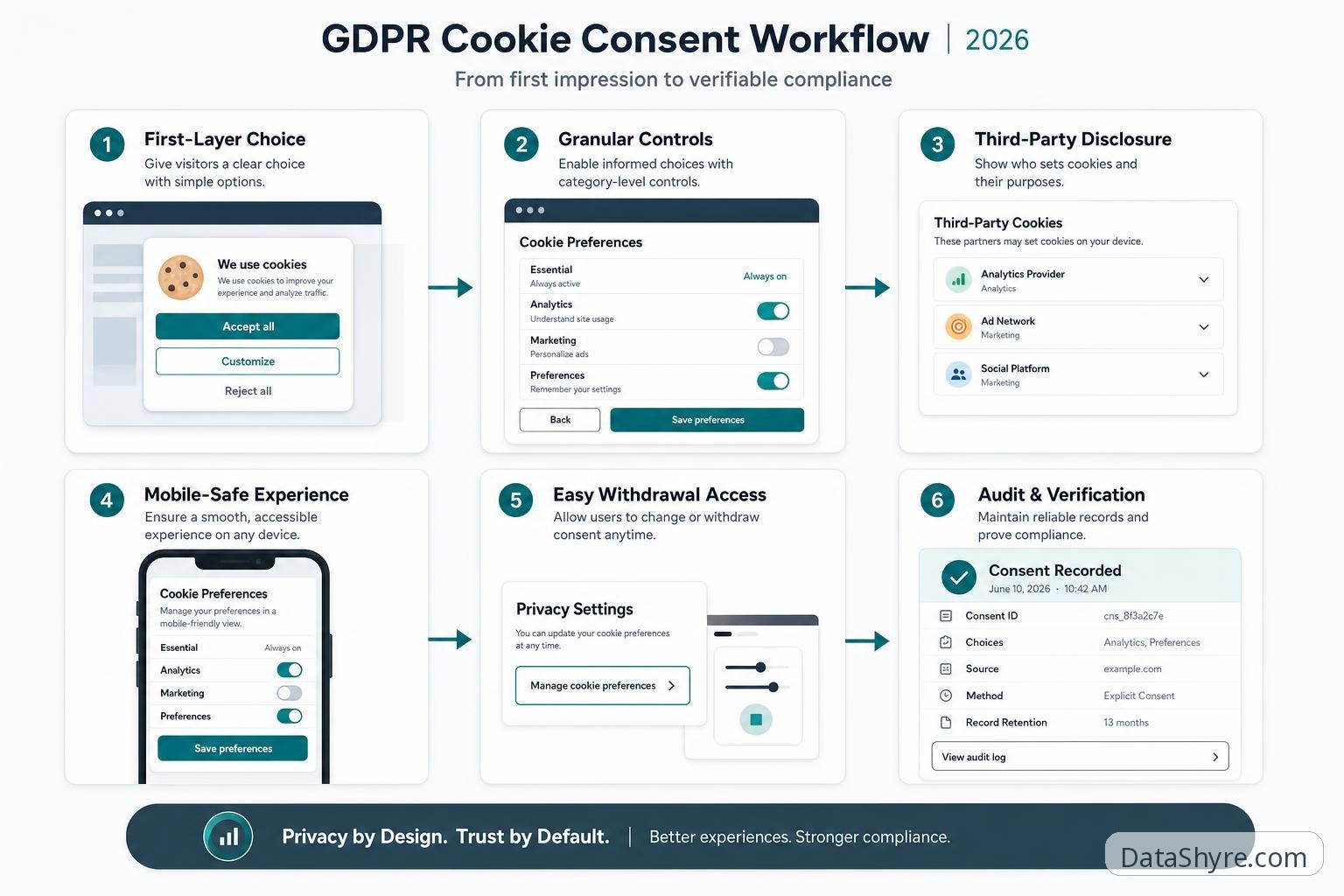
A stronger banner does not just say “we use cookies to improve your experience.” It separates the actual purposes people can evaluate, such as:
- analytics or measurement;
- advertising or remarketing;
- personalization;
- social, video, or other embedded features that involve optional tracking.
Granularity is not there to make the user work harder. It is there to stop the site from hiding unlike activities inside one convenient yes.
5. Make rejection as easy as acceptance
This is the design check regulators keep repeating.
The European Commission says people must be able to refuse or withdraw consent without disadvantage. CNIL’s December 12, 2024 formal notices put the cookie-banner version even more plainly: “Rejecting cookies should be just as easy as accepting them.” The notices describe familiar failure patterns: low-visibility reject links, placement that hides refusal in surrounding text, and interfaces that repeat acceptance options while making rejection harder to find.
For gdpr cookies requirements, the first-layer review should be blunt:
- is
Reject allavailable without opening a maze; - is it visually comparable to
Accept all; - is the language explicit on mobile as well as desktop;
- after rejection, do optional technologies stay off on refresh.
If refusal is technically possible but operationally inconvenient, the design is still taking risk.
6. Tell people what is happening in plain language
The Commission’s consent page still says the request for consent should use “clear and plain language” and state clearly all the reasons for the processing. It also says the person should be told enough to understand the consequences of the choice.
That means gdpr cookies requirements are not satisfied by a banner that only says “we and our partners use cookies.”
A useful explanation helps a normal person answer:
- what each optional purpose covers;
- which third parties are involved;
- how long the identifier or access persists;
- how to change the choice later.
If the explanation only makes sense to the implementer, it is probably not informed consent.
7. Make withdrawal, proof, and change control operational
Consent work is not finished when the banner ships.
The Commission still says it should be as easy to withdraw as to give consent, and that the controller must be able to demonstrate that the individual consented. The ICO’s current guidance says you must have the technical capability to let users withdraw with the same ease, and if you introduce a new technology or a different purpose you must obtain fresh consent.
That makes the final gdpr cookies requirements check very practical:
- can a visitor reopen preferences and reverse the decision quickly;
- does withdrawal actually stop future optional reads, writes, and calls;
- can you show which banner version and purpose choices were presented;
- do you retest when tags, vendors, embeds, or regional logic change.
That last point matters because the stack drifts. The EDPB’s July 14, 2026 VRT cookie-banner decision is a useful reminder that cookie-banner complaints are still active enforcement territory, not a solved 2021 problem.
A practical review sequence for this week
If you were reviewing gdpr cookies requirements on a live site today, I would work in this order:
- inventory every technology that can store or access information on the device;
- challenge the strictly necessary labels first;
- test first load in a clean browser and verify optional technologies stay off;
- compare
Accept allandReject allfor equal ease and visibility; - test granular purpose choices, not just full acceptance;
- withdraw consent later and verify the runtime changes too;
- save evidence of what the user saw and what the site actually did.
That sequence surfaces more truth than another round of banner copy edits.
Bottom line
GDPR cookies requirements in 2026 are still about control before collection, not cosmetics after the fact.
If a technology is optional, keep it off until the visitor makes a real choice. Ask by purpose. Make refusal and withdrawal easy. Explain the consequences clearly. Then keep proof that the runtime matched the promise.
The practical test for gdpr cookies requirements is simple: if the site can explain the rule, enforce the choice, and keep that behavior stable through ordinary releases, the setup is moving in the right direction.
Sources
- https://commission.europa.eu/law/law-topic/data-protection/information-business-and-organisations/legal-grounds-processing-data_en
- https://www.edpb.europa.eu/system/files/2026-04/edpb-summary-consent_en.pdf
- https://www.edpb.europa.eu/news/edpb-requires-belgian-dpa-to-handle-the-merits-of-noyb-cookie-banner-complaint_en
- https://ico.org.uk/about-the-ico/media-centre/news-and-blogs/2026/04/final-storage-and-access-technologies-guidance-published/
- https://ico.org.uk/for-organisations/direct-marketing-and-privacy-and-electronic-communications/guidance-on-the-use-of-storage-and-access-technologies/how-do-we-comply-with-the-pecr-rules/
- https://ico.org.uk/for-organisations/direct-marketing-and-privacy-and-electronic-communications/guidance-on-the-use-of-storage-and-access-technologies/how-do-we-manage-consent-in-practice/
- https://www.cnil.fr/en/dark-patterns-cookie-banners-cnil-issues-formal-notice-website-publishers
- https://eur-lex.europa.eu/legal-content/EN/TXT/?uri=CELEX:62017CJ0673
—
Published: October 16, 2026. Updated using current official European Commission, EDPB, ICO, CNIL, and EUR-Lex materials available at publication time.