

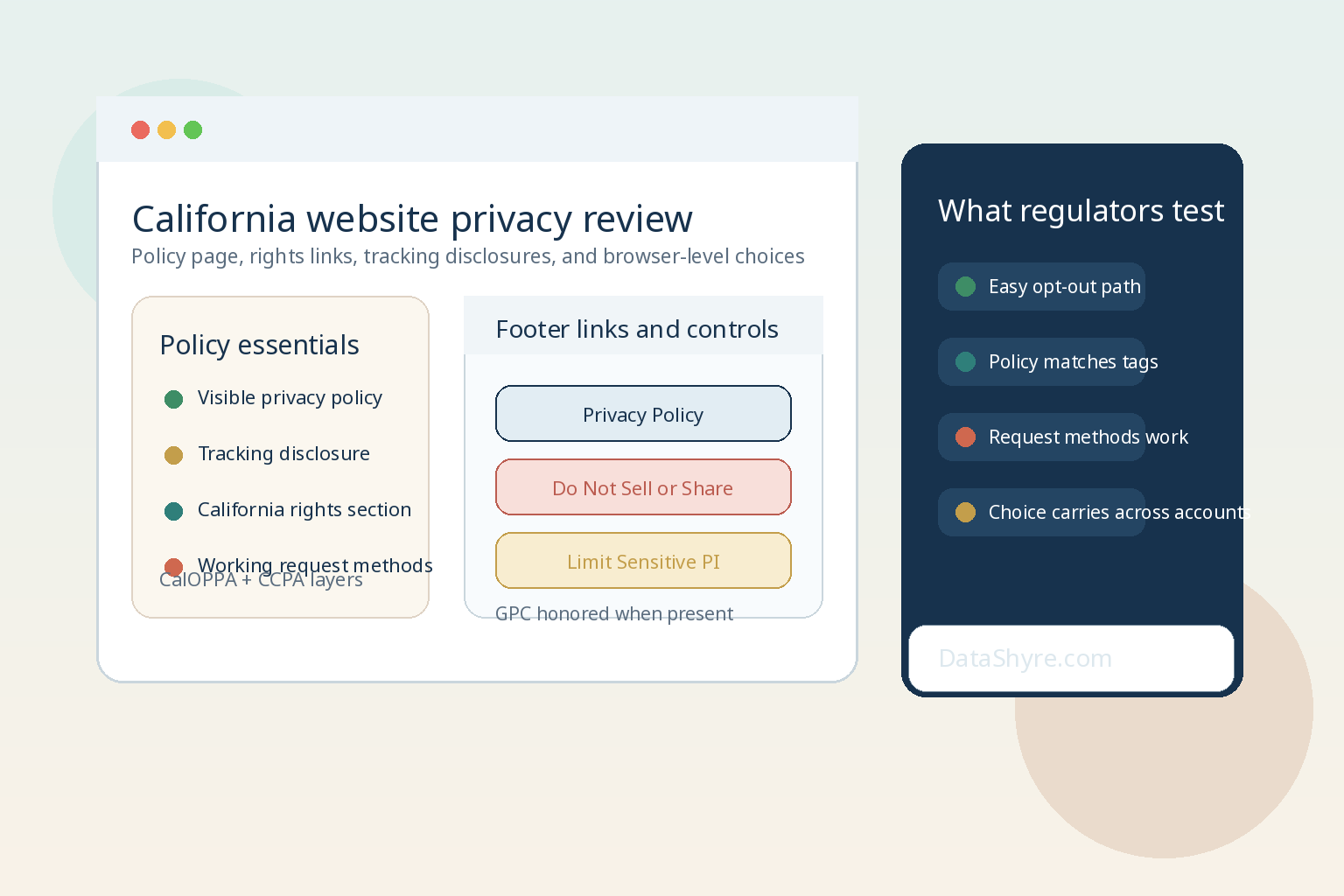
California Web Privacy Law in 2026: What Your Website Actually Has to Show
Teams researching california web privacy law usually do not need another generic privacy article. They need a practical read on how the controls behave on a live build, where the friction shows up, and what should be tested before a site ships.
That distinction matters because many teams still collapse everything into one vague question about whether a website needs a privacy policy. It usually does. But not every California-facing site has every CCPA duty, and not every privacy-policy issue is really a CCPA-threshold issue.
If you want the broader California backdrop first, start with these guides to California consumer privacy, California data privacy protection act, and California privacy law delete data. This version is narrower. It answers what california web privacy law usually means on a live website in late 2026.
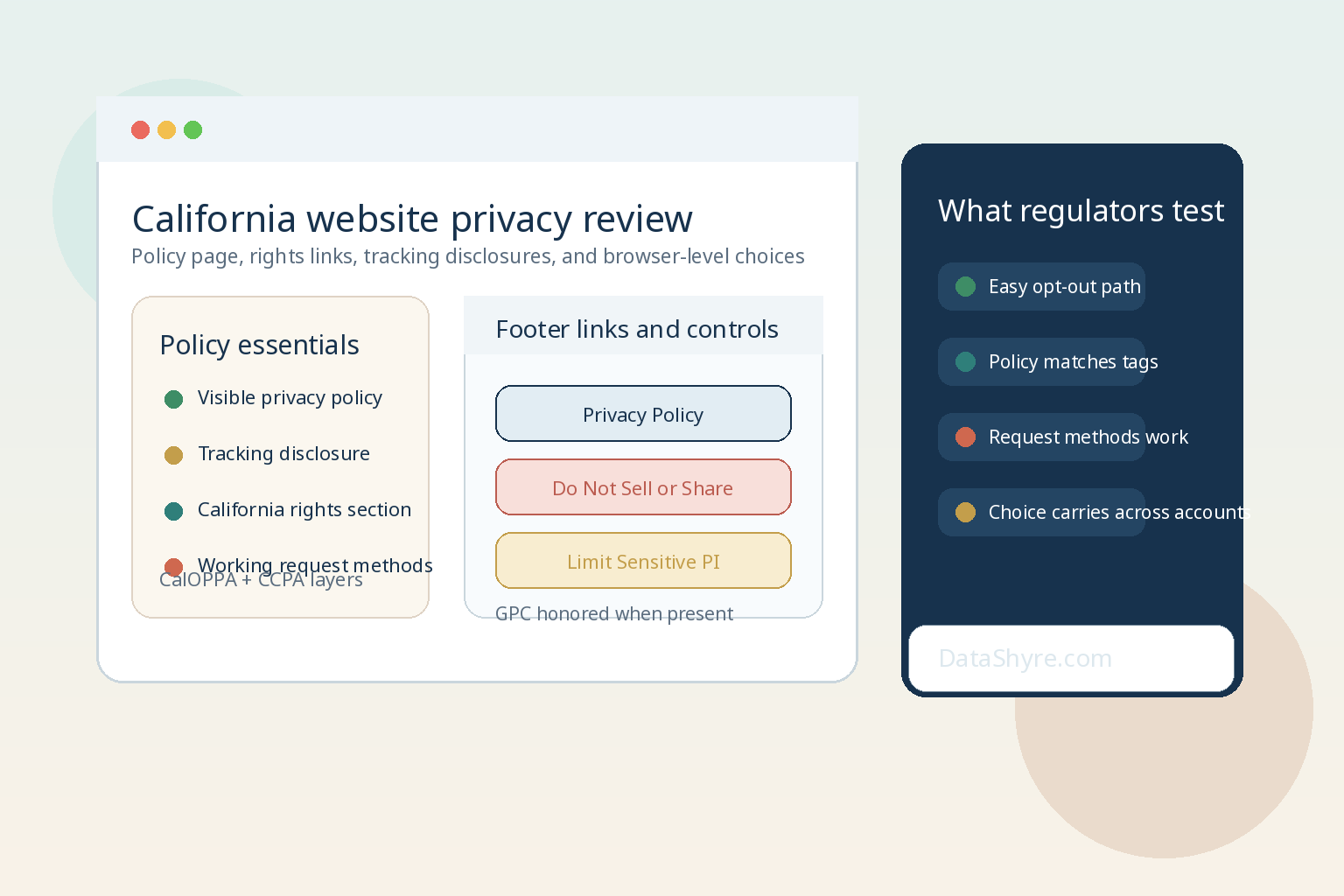
The first California website rule is still CalOPPA
This is the part many teams forget because the CCPA gets more attention.
California’s Department of Justice still explains that the California Online Privacy Protection Act of 2003, or CalOPPA, applies to operators of commercial websites that collect personally identifiable information from California consumers. The law also reaches online services, not only classic websites.
So if the real question behind california web privacy law is, Do I need a privacy policy on my site?, the practical answer is still yes if your commercial site or online service collects personal information from Californians.
That is the baseline layer.
What CalOPPA still expects on the site
CalOPPA is not only about having a policy somewhere in company records. It is about posting one where people can actually find it.
The statute still requires operators to “conspicuously post” a privacy policy, and California’s public-facing privacy guidance still points consumers to policies posted on website homepages and app landing or download pages. In practical terms, the policy should explain what information the site collects, why it collects it, how it uses it, what categories of third parties may receive it, and what choices the consumer has.
For operators, that creates a simple website test:
- Is the privacy policy easy to reach from the public-facing site?
- Does it describe what the site actually collects and does?
- Does it describe third-party access clearly enough to match reality?
- Does it explain the consumer choices that really exist?
If the answer to any of those is no, the problem may start before you even reach the CCPA layer.
California still expects tracking disclosures too
There is another California website point that often gets buried.
The 2013 AB 370 amendment to CalOPPA still matters because it requires a privacy policy to explain how the operator responds to a browser Do Not Track signal or similar mechanism, and whether third parties may be collecting personally identifiable information about a consumer’s online activities over time and across different services.
That means california web privacy law is not only about drafting a generic policy page. It is also about being concrete about tracking behavior and third-party activity on the site.
In real deployments, that should push teams to review:
- analytics tools;
- advertising and retargeting tags;
- session-replay or similar behavior tools;
- embedded video, chat, and social widgets;
- and any vendor script that observes user activity across contexts.
If the policy still reads like a pre-ad-tech template while the site runs a modern tracking stack, the disclosure layer is already drifting.
When the CCPA layer applies to a website
This is where the question gets more specific.
The CCPA does not apply to every organization with a website. California’s current materials still frame it as applying to for-profit businesses doing business in California that meet one or more statutory thresholds. If your organization is covered, the website privacy analysis changes quickly because the site becomes part of the rights and notices workflow, not just a place to host a policy.
That makes the smarter framing for california web privacy law:
- CalOPPA is the broad website privacy-policy baseline; and
- CCPA/CPRA adds the heavier notice, rights, and opt-out duties for covered businesses.
This is why smaller teams sometimes overstate or understate their obligations. They either assume one privacy page solves everything, or they assume every California-facing page creates full CCPA exposure by itself. Neither shortcut is reliable.
What a covered website should show beyond the basic policy
Once a business is within the CCPA layer, California expects much more than a footer link.
California’s own consumer-facing materials still say privacy policies for CCPA-subject businesses should explain consumer rights and the ways consumers can exercise them. The current regulations effective January 1, 2026 also still specify required disclosures, notices, request methods, timelines, and opt-out preference signal handling.
That means a covered website should not leave the user guessing about:
- how to access collected personal information;
- how to request deletion or correction;
- how to opt out of sale or sharing where applicable;
- how to limit sensitive personal information where that right applies;
- and how the site handles California-specific rights in practice.
This is where many sites fail the operational version of california web privacy law. The policy sounds comprehensive, but the request path is hidden, broken, or routed into a general support queue that was never designed for privacy requests.
GPC is still part of the live website test
California’s current guidance makes this especially clear.
The state’s current Global Privacy Control guidance describes GPC as a browser-level “stop selling or sharing my data switch.” The CPPA FAQ also still says covered businesses must honor qualifying opt-out preference signals such as GPC as a valid request to opt out of sale or sharing.
That makes GPC one of the most practical checks inside california web privacy law today.
If your site sells or shares personal information, ask:
- Does the site detect a GPC signal?
- Does it honor that signal in the actual ad-tech or sharing workflow?
- Does the policy explain the opt-out path clearly?
- Does the account or cross-device experience line up with that promise?
California has been pushing hard on this point because browser-level choice is only meaningful when the site behavior actually changes.
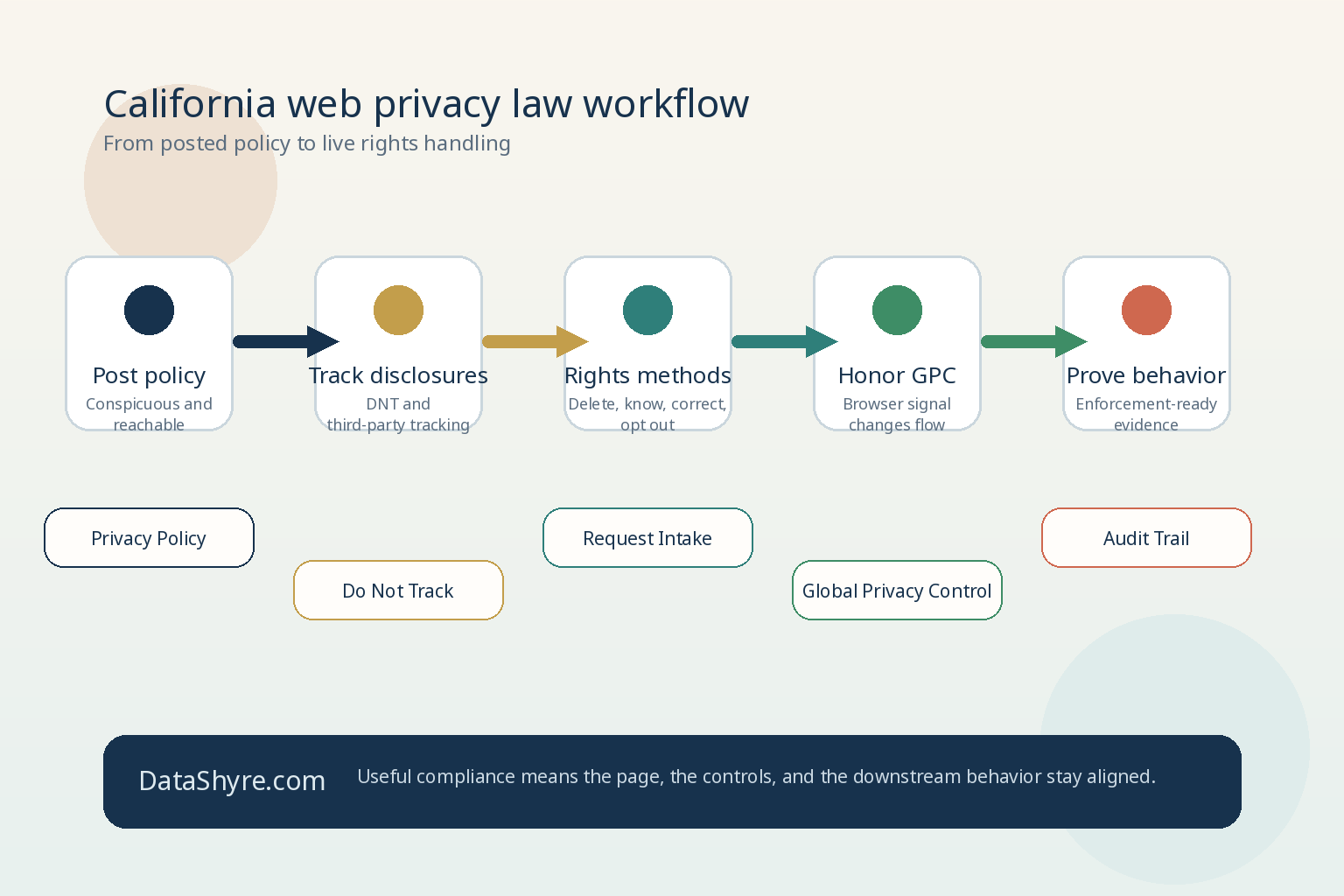
What current enforcement examples still catch
The easiest way to understand california web privacy law in 2026 is to look at what California has been willing to allege on real properties.
The state’s published enforcement materials and recent settlements still point to the same breakpoints:
- weak or hard-to-find opt-out paths;
- privacy pages that do not match live tracking behavior;
- broken or incomplete request methods;
- and account-level or cross-device opt-out logic that does not actually carry the user’s choice.
That shows up especially clearly in recent California actions. In the Healthline matter, the Attorney General said the publisher’s use of online tracking technology violated the CCPA by failing to allow customers to opt out of targeted advertising and by sharing data with third parties without the required privacy protections. In the Disney settlement announced on February 11, 2026, Attorney General Rob Bonta said businesses cannot force people to “go device-by-device or service-by-service” to stop the sale or sharing of their data.
Those examples matter because they show that California is not treating privacy pages as decorative compliance assets. It is asking whether the website experience, account logic, ad-tech wiring, and contracts all line up with what the user was told.
A short audit for a California-facing website
If you were reviewing a site this week for california web privacy law, I would check it in this order:
- confirm whether the site collects personal information from Californians and therefore needs the CalOPPA privacy-policy baseline;
- check whether the privacy policy is conspicuous and easy to reach from the public site;
- review whether the policy accurately describes categories collected, purposes, third-party access, and consumer choices;
- check whether the policy explains tracking disclosures, including the site’s response to Do Not Track or similar mechanisms;
- confirm whether the business is actually in CCPA scope;
- if it is, test the California rights section and every listed submission method;
- if sale or sharing is in scope, test GPC and any opt-out links on a live browser session;
- compare the written disclosures against the real vendor and tracking stack.
That short review usually surfaces the real defects faster than arguing in the abstract about whether a site is compliant.
Bottom line
California web privacy law in 2026 is still not one single rule.
For many sites, the starting point is still CalOPPA: post a visible privacy policy and make sure it actually reflects what the site collects and how it tracks. For covered for-profit businesses, the CCPA/CPRA adds the heavier layer: rights disclosures, request methods, opt-out handling, and GPC recognition that work in real life, not just on paper.
The practical test for california web privacy law is simple: if the site can explain the rule, enforce the choice, and keep that behavior stable through ordinary releases, the setup is moving in the right direction.
Sources
- California Legislative Information: CalOPPA
- California DOJ: How to Read a Privacy Policy
- California DOJ: Privacy Legislation Enacted in 2013
- California DOJ: California Consumer Privacy Act
- California DOJ: Global Privacy Control
- California DOJ: Privacy Enforcement Actions
- California DOJ: Healthline settlement
- California DOJ: Disney settlement
- California Privacy Protection Agency: FAQs
- California Privacy Protection Agency: Laws & Regulations
- California Privacy Protection Agency: CCPA regulations effective January 1, 2026
—
Published: October 15, 2026. Updated using current official California regulator, government, and statutory materials available at publication time.