
EMARKETER Consent Management Platform in 2026: 7 Buyer Checks That Matter on Live Sites
Teams researching emarketer consent management platform usually do not need another generic privacy article. They need a practical read on how the controls behave on a live build, where the friction shows up, and what should be tested before a site ships.
For adjacent context, start with the linked DataShyre guides, then validate the controls on a live build so implementation gaps show up before release.
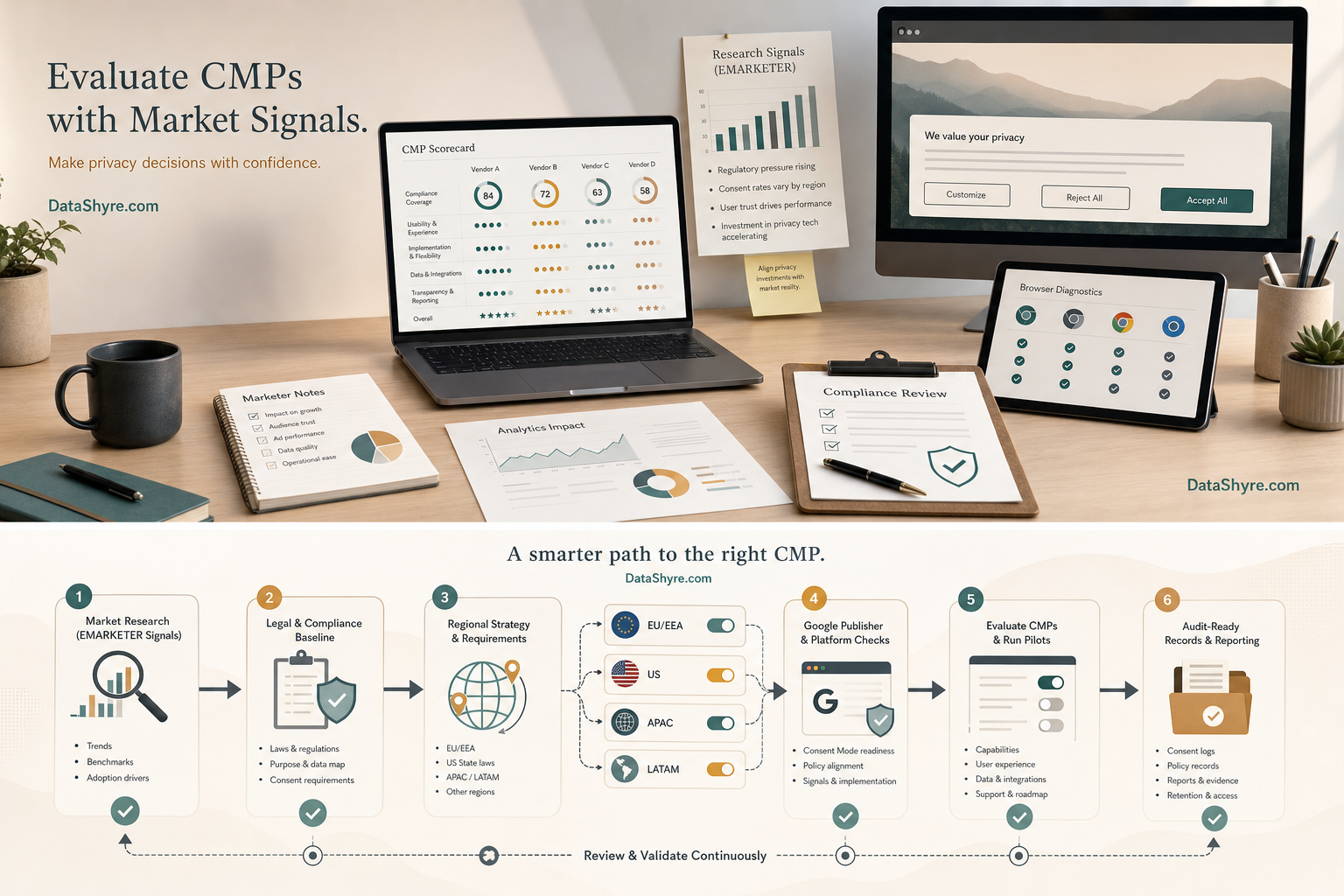
That distinction matters because EMARKETER’s recent privacy coverage frames consent and preference tooling as part of a larger privacy-led marketing shift. That is directionally useful. It is not the same thing as verifying whether a platform creates valid consent, handles California browser signals, or changes tag behavior before optional measurement begins.
The legal and implementation floor is still the part that decides whether a CMP rollout is strong. The European Commission still says valid consent must be freely given, informed, specific, and based on a clear affirmative act, and it says withdrawal must be “as easy to use as giving consent.” The UK’s ICO finalized its storage-and-access-technologies guidance on April 29, 2026, including new material on objection handling and multi-purpose technologies. California’s Department of Justice still describes Global Privacy Control as a “stop selling or sharing my data switch” that covered businesses must honor. Google’s current consent-mode guidance still starts with the same operational rule: “Before a user grants consent” you set the default state first.
If you want adjacent reading first, these guides to consent management platform, consent management platform best practices, and Usercentrics consent management platform cover the wider stack. This article is narrower. It is the seven-check buyer sequence I would use if the keyword in front of me were specifically emarketer consent management platform.
What the keyword usually means
This query usually reflects research intent, not product intent.
People typing emarketer consent management platform are often trying to answer one of these questions:
- which CMPs are being discussed in the marketing and privacy space right now;
- whether consent tooling is now a board-level or budget-level priority;
- how privacy-first marketing changes CMP selection;
- or how to turn trend coverage into a vendor shortlist that will survive a real implementation review.
This is why the most useful answer is not another feature dump. It is a shortlist framework that connects market language to legal and technical reality.
1. Separate market signal from compliance proof
This is the first discipline that keeps the keyword useful.
EMARKETER’s current privacy coverage is valuable because it shows how marketers are thinking about trust, first-party data, and operational privacy pressure. Its April 7, 2026 report Digital Privacy Trends 2026 says privacy pressures are reshaping digital advertising and raising the stakes for marketers. Its November 6, 2025 article on privacy-led growth says consent and preference management platforms can streamline processes and build customer trust.
That is a reasonable market view. But it does not prove that a CMP:
- captures valid consent where prior consent is required;
- makes refusal as easy as acceptance;
- honors California opt-out and GPC flows;
- sets default Google states before optional measurement starts;
- or leaves behind records a real team can explain later.
So if you landed here through emarketer consent management platform, take the market signal seriously, but do not mistake it for runtime evidence.
2. Check whether the platform creates a fair first choice
The best CMP buying conversations still start with the same simple test: what happens on the first layer?
The European Commission’s guidance remains a clean baseline. Consent has to be freely given, informed, specific, and based on an affirmative act. Withdrawal has to stay easy. That means a platform should help you present a real choice, not a cosmetic one.
For an emarketer consent management platform review, test:
- whether
Reject allis visible when your jurisdictional model requires it; - whether button hierarchy nudges acceptance harder than refusal;
- whether category labels explain the actual use case instead of hiding behind soft language;
- whether users can reopen the control later without friction.
If the first layer is manipulative, the rest of the platform is already starting in a hole.
3. Verify whether the platform changes live behavior before tags run
This is where many vendor evaluations get too theoretical.
Google’s current consent-mode guidance is helpful because it is explicit about timing. You set the default state before measurement commands depend on it, and Google says consent updates should be tracked on the page where the user acts before any page transition. That is not a policy slogan. It is an implementation sequence.
So for any emarketer consent management platform shortlist, run four live checks:
- first visit with no stored choice;
- explicit reject;
- explicit accept;
- later withdrawal or settings change.
Then inspect what actually happens:
- do optional analytics or ad tags move too early;
- do embeds or late scripts bypass the CMP;
- does the later withdrawal state really propagate;
- can engineering describe the timing path without guesswork.
This is where market confidence meets browser reality.
4. Treat EU or UK consent and California opt-out as different jobs
This is one of the easiest ways to overrate a demo.
In much of the EU and UK, the practical question often starts with whether non-essential storage and access technologies stay off until valid consent exists. The ICO’s finalized 2026 guidance matters because it covers a wider surface than classic cookie-banner talk. The scope includes cookies, tracking pixels, device fingerprinting, and related technologies.
California often asks something different. The state still expects covered businesses to honor a valid GPC signal for sale or sharing opt-out handling, and California’s current law-and-regulations page shows the current CCPA and CCPA Regulations as effective January 1, 2026.
So when you evaluate an emarketer consent management platform, do not accept one blended demo path. Ask for separate reviews of:
- prior-consent behavior for optional technologies in EU or UK flows;
- California opt-out and GPC handling for sale or sharing workflows;
- preference-center behavior after the initial choice;
- evidence showing which regional logic fired and why.
One banner can span multiple regions. One legal theory should not.
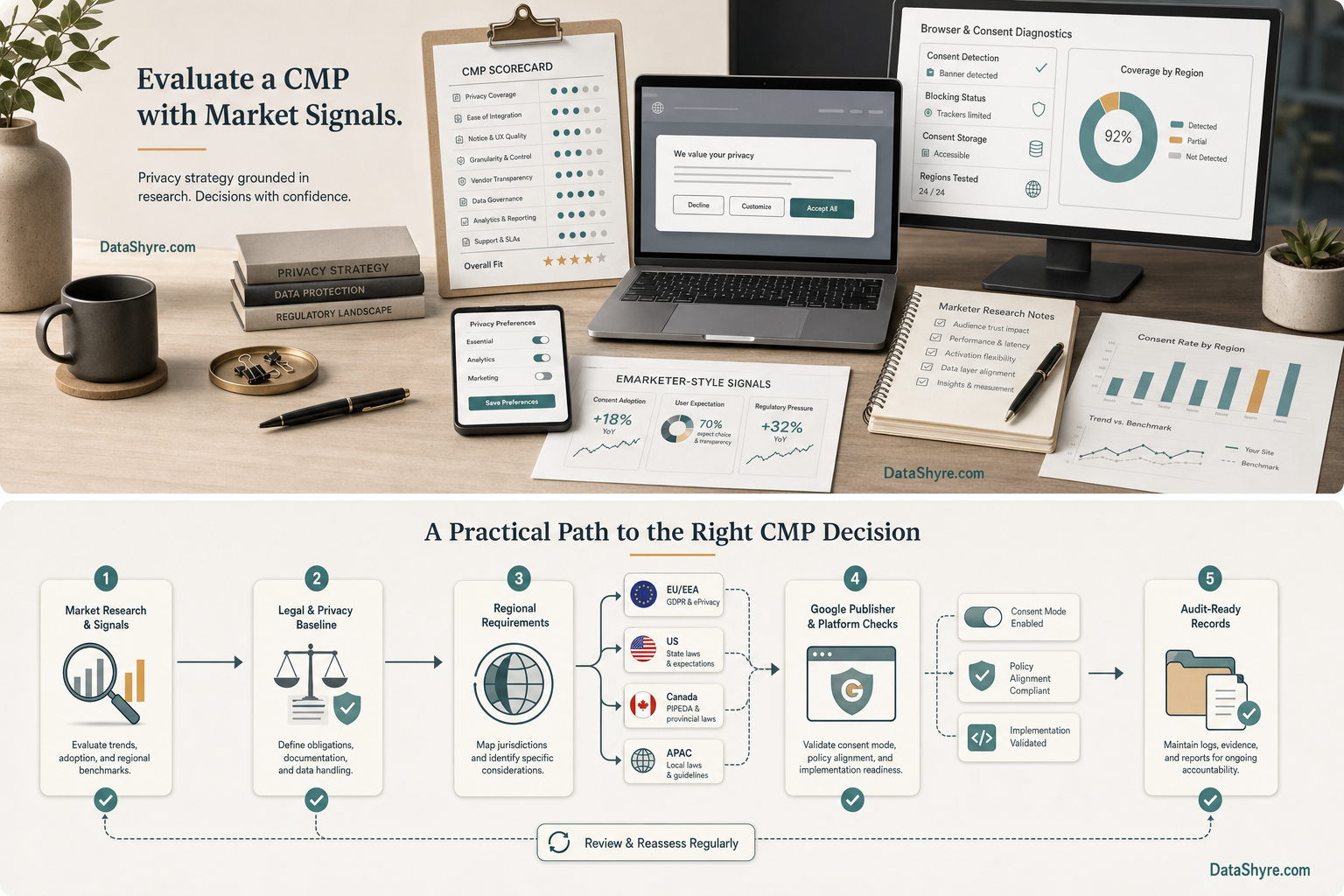
5. If advertising revenue matters, run the Google publisher branch separately
This is where generic CMP research often stays too high level.
Google’s current publisher guidance still says that publishers using AdSense, Ad Manager, or AdMob must use a Google-certified CMP integrated with the IAB Transparency and Consent Framework when serving personalized ads to users in the EEA and UK as of January 16, 2024, and in Switzerland as of July 31, 2024. Google also says its certification checks are not the same thing as full legal compliance.
That means a platform can pass the publisher-product requirement and still be weak on first-layer fairness, California handling, or internal explainability. The reverse can happen too.
For emarketer consent management platform buying, ask two separate questions:
- does this platform satisfy the Google publisher path where our monetization model needs it;
- does it also satisfy the broader legal and operational standard we need outside that path.
That split removes a lot of confusion from vendor comparisons.
6. Check whether the records explain both the notice and the technical result
A CMP is not just a collection interface. It is an evidence system.
The stronger emarketer consent management platform options should let you reconstruct:
- what notice or banner version the user saw;
- which categories or purposes were shown;
- what the user selected and when;
- which regional model applied;
- what technical state followed from the selection;
- what changed after later withdrawal or updates.
This is where many stacks fail the real support test. They can show a yes-or-no record, but not a coherent story that connects notice, choice, and actual technical behavior.
If a non-technical stakeholder cannot follow the record without a specialist interpreter, the platform may still be too fragile.
7. Ask how the platform handles drift after launch
This is the buyer check market summaries tend to underrate.
Privacy stacks rarely break because the original demo was impossible. They break because the site changes. A new marketing script appears. A vendor is added. A tag container is republished. An app team ships a new SDK. A preferences table stops matching what is really live.
The ICO’s 2026 guidance matters here because it reflects a broader tracking surface than cookie-only reviews. This is why a durable emarketer consent management platform should help you manage drift with some combination of:
- rescans or change detection;
- uncategorized-script review;
- region-aware governance;
- records that reveal when the live implementation diverged from the declared model.
If the platform only looks trustworthy on launch day, it is not mature enough for most serious teams.
A practical shortlist sequence for this keyword
If I were translating emarketer consent management platform into a real buying process this week, I would work in this order:
- decide whether the underlying need is website consent, broader preference management, or publisher monetization;
- set the legal baseline first using EU or UK consent rules, California opt-out handling, and any publisher-specific requirements that apply;
- ask each vendor to prove first-load behavior, reject behavior, accept behavior, and later withdrawal behavior;
- inspect regional branching instead of assuming one banner flow can solve every jurisdiction cleanly;
- export the evidence and decide whether your legal, product, and marketing teams could all understand it;
- check what the platform does when the site changes after launch.
That sequence usually tells you more than another glossy analyst-style comparison table.
Bottom line
The phrase emarketer consent management platform is best treated as a market-intent keyword.
It points to a real buyer problem in 2026: how do you move from privacy-market research and trend language to a CMP decision that still holds up under live legal requirements, live browser behavior, and future stack changes?
The practical test for emarketer consent management platform is simple: if the site can explain the rule, enforce the choice, and keep that behavior stable through ordinary releases, the setup is moving in the right direction.
Sources
- European Commission: Legal grounds for processing data
- ICO: Guidance on the use of storage and access technologies
- California Department of Justice: California Consumer Privacy Act (CCPA)
- California Department of Justice: Global Privacy Control
- California Privacy Protection Agency: Laws and regulations
- Google for Developers: Set up consent mode on websites
- Google AdSense Help: Google consent management requirements for serving ads in the EEA, the UK, and Switzerland (for publishers)
- EMARKETER: Digital Privacy Trends 2026
- EMARKETER: Why privacy-led growth gives marketers better data and stronger trust
—
Published: October 15, 2026. Updated using current official regulator, government, platform, and market-research materials available at publication time.