
GDPR Cookie Consent Google Tag Manager in 2026: 7 Live Checks Before Your Container Leaks
Teams researching gdpr cookie consent google tag manager usually do not need another generic privacy article. They need a practical read on how the controls behave on a live build, where the friction shows up, and what should be tested before a site ships.
For adjacent context, start with the linked DataShyre guides, then validate the controls on a live build so implementation gaps show up before release.
That is the sharper standard in current official material. Google’s current consent guide still starts with “Before a user grants consent” you set the default state. Tag Manager help still says the Consent Initialization trigger runs “before all other tags.” The European Commission still says withdrawal must be “as easy to use as giving consent.” The ICO’s April 29, 2026 storage-and-access-technologies announcement says the goal is “meaningful control over how their data is used.”
For adjacent context, start with these guides to tag manager cookie consent, cookie consent Google Tag Manager, and GDPR consent requirements. This page is narrower. It is the seven-check review I would run this week for gdpr cookie consent google tag manager on a live GTM stack.
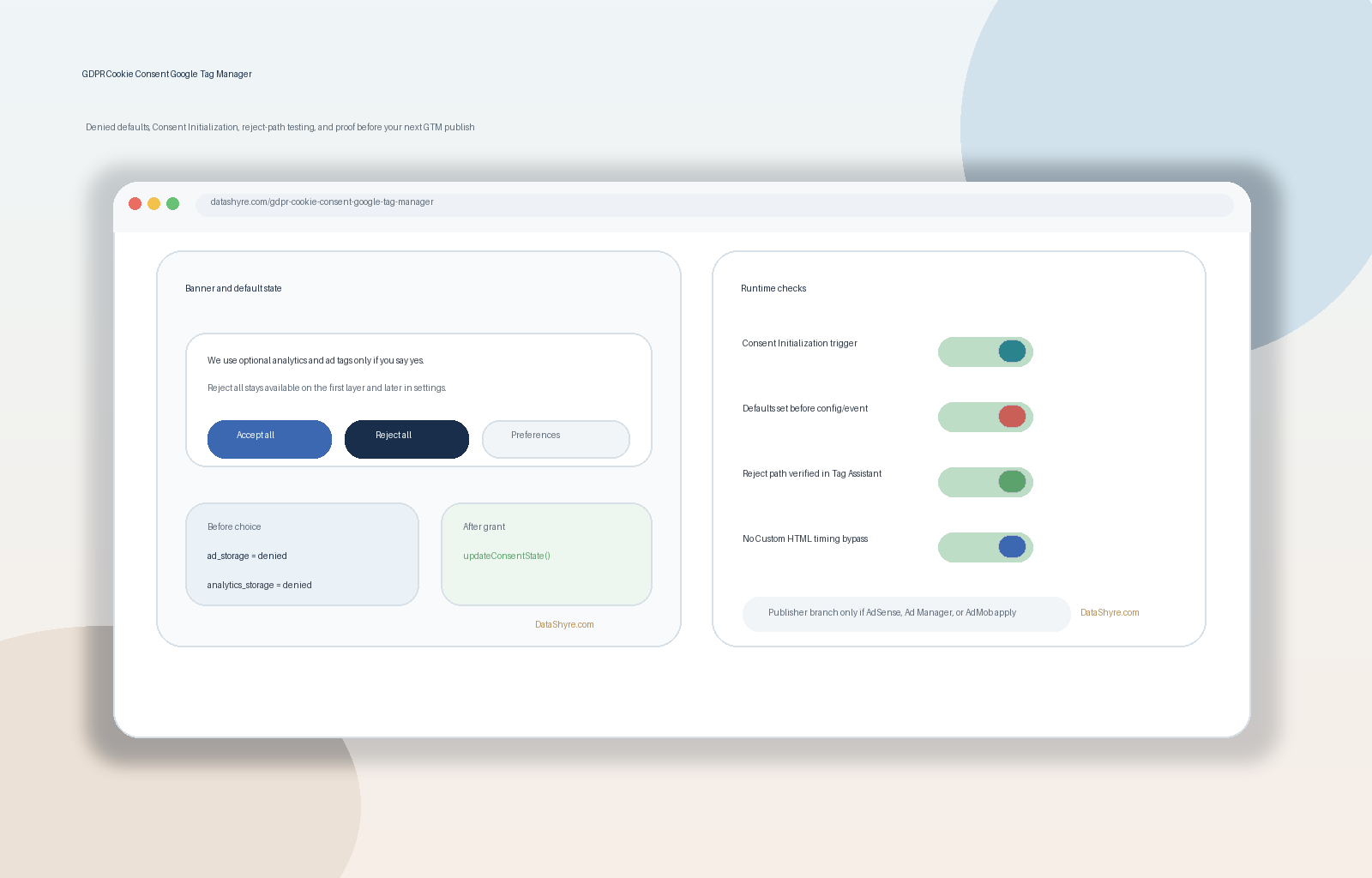
1. Treat GDPR cookie consent in GTM as a sequencing problem first
The first mistake in gdpr cookie consent google tag manager is treating the banner as the implementation.
It is not. The banner is the visible layer. The real control sits in the order underneath it:
- default consent states;
- page-load trigger order;
- tag-level consent behavior;
- later updates after the user acts;
- proof that the runtime matched the promise.
This is why the legal baseline and the technical baseline have to meet. The Commission’s consent guidance still says valid consent has to be specific, informed, and easy to withdraw. The GTM side turns that into a simpler engineering question: did optional tags wait?
2. Put consent-writing logic on Consent Initialization, not on a race you hope to win
This is still the most important implementation checkpoint.
Google’s current Tag Manager help says the Consent Initialization trigger is designed to ensure consent settings are honored before any other triggers fire, and that it will fire “before all other tags” including Initialization triggers.
For gdpr cookie consent google tag manager, that usually means your CMP tag or consent template belongs on Consent Initialization - All Pages, not on a normal page-view trigger and not in a callback that tries to catch up later.
The weak pattern still looks familiar:
- GTM loads;
- one or more measurement or custom tags start evaluating;
- the CMP script updates consent afterward.
That is a timing gamble, not a consent control.
3. Denied defaults need to land before any measurement command depends on them
Google’s developer guide is still explicit here: “Before a user grants consent” you set defaults, and for gtag.js you call the default consent command before any commands that send measurement data.
For a serious gdpr cookie consent google tag manager review, test at least these states:
- first visit with no stored choice;
- explicit reject;
- explicit accept;
- later withdrawal;
- a second pageview after withdrawal.
If the default-denied state arrives late, the implementation may still look compliant in screenshots because later events behave correctly. The problem is that the first load already escaped the rule.
4. Make refusal as usable as acceptance, then confirm the runtime actually honors it
This is where policy language and enforcement language line up unusually well.
The European Commission still says withdrawal must be as easy as giving consent. CNIL’s current cookie-banner enforcement message is even blunter: “rejecting cookies should be just as easy as accepting them.” The ICO’s cookies guidance also still says valid consent “must be more than simply continuing to use the website.”
So for gdpr cookie consent google tag manager, test two layers, not one:
- the interface layer:
- the runtime layer:
Reject all is visible, explicit, and not visually buried;
non-essential tags really stay blocked after rejection and after refresh.
A balanced banner that still lets a tag fire early is not a compliant implementation. It is a better costume.
5. Review Google tag settings and custom-tag bypasses separately
One of the quiet failure modes in gdpr cookie consent google tag manager is assuming every tag follows the same rules automatically.
Google’s current help on consent mode support says GTM includes built-in consent checks, tag consent settings, and a Consent Overview page. The same help also warns that commands executed in callbacks or through gtag() in Custom HTML are not guaranteed to be available before the next trigger fires. Google’s current troubleshooting guidance also warns that blocking or delaying Google tags can reduce or disable modeled behavior and that Tag Assistant should be used to verify what fired.
That means a live audit should split the review:
- Google tags using built-in consent behavior;
- Custom HTML tags that may bypass timing or consent APIs;
- third-party vendors that need their own blocking or routing checks.
This matters even more after Google’s June 15, 2026 Analytics data-controls change, because Google says Consent Mode settings in Google Ads are now the single control for Google Ads data flowing from Analytics, while Google Signals in Analytics is narrowed to behavioral reporting.
6. If you serve publisher ads, run a separate certified-CMP branch
This is not relevant for every site, but it matters for many media and ad-supported properties.
Google’s current publisher help still says AdSense, Ad Manager, and AdMob partners serving personalized ads in the EEA and UK must use a Google-certified CMP integrated with the IAB Transparency and Consent Framework as of January 16, 2024, and that the same requirement applies in Switzerland as of July 31, 2024. Google also says its CMP review does not check full compliance with privacy law.
That distinction matters because a stack can satisfy the Google publisher program requirement and still be weak on first-layer fairness or default timing. The reverse can happen too.
So for gdpr cookie consent google tag manager, keep two questions separate when ads matter:
- does the GTM and CMP setup satisfy GDPR-style prior-consent requirements for optional tracking;
- does the publisher stack also satisfy Google’s certified-CMP and TCF requirement where it applies.
Those checks overlap. They are not the same check.
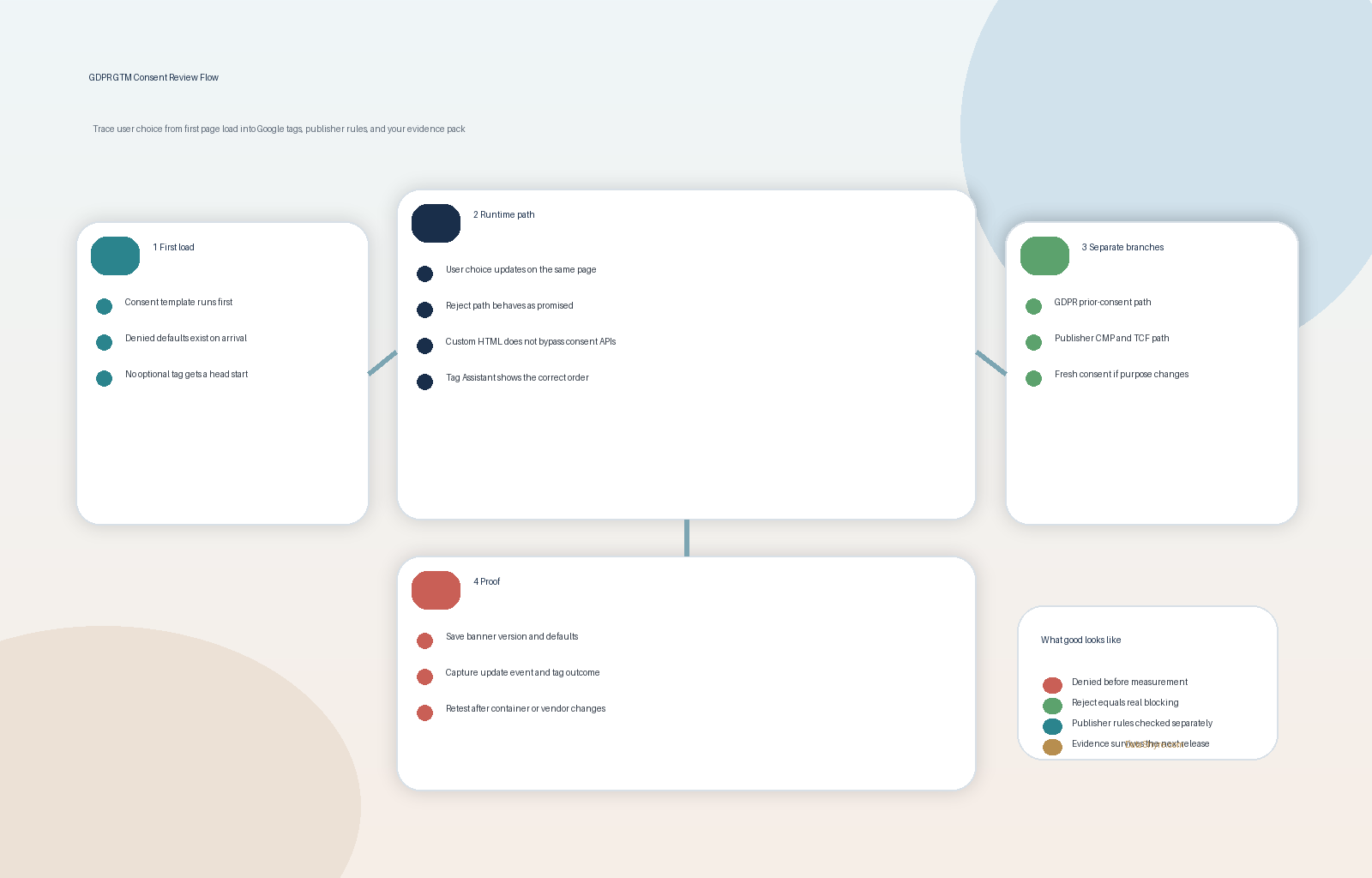
7. Save evidence and retest when anything changes
The implementation is not finished when the banner appears once in staging.
The ICO’s current storage-and-access-technologies guidance says that if you introduce a new technology or a new purpose, you need fresh consent for that new technology or purpose. That is the operational reason gdpr cookie consent google tag manager should be treated as release work.
The evidence pack should usually let your team reconstruct:
- what banner or preference-center version the user saw;
- what the default consent states were;
- when the update event fired;
- what Tag Assistant showed for the resulting tag behavior;
- what changed after the latest CMP, container, or vendor release.
Without that, your proof disappears the moment the site changes.
A short live review sequence for this week
If you were reviewing gdpr cookie consent google tag manager on a live property today, I would work in this order:
- confirm the CMP or consent template runs on Consent Initialization;
- verify denied defaults exist before measurement depends on them;
- test reject, accept, and later withdrawal on real pages;
- inspect Consent Overview, Tag Assistant, and any custom HTML paths;
- split the publisher-ad branch out separately if it applies;
- save the evidence pack before the next container publish changes the state again.
That sequence usually exposes the real weakness faster than another round of banner-copy edits.
Bottom line
The cleanest way to think about gdpr cookie consent google tag manager in 2026 is this: the project is not finished when the banner renders.
The practical test for gdpr cookie consent google tag manager is simple: if the site can explain the rule, enforce the choice, and keep that behavior stable through ordinary releases, the setup is moving in the right direction.
Sources
- Google for Developers: Set up consent mode on websites
- Google Tag Manager Help: Page view triggers
- Google Analytics Help: Tag Manager consent mode support
- Google Analytics Help: Updates to Google Analytics Data Controls
- Google AdSense Help: Google consent management requirements for serving ads in the EEA, the UK, and Switzerland (for publishers)
- European Commission: Legal grounds for processing data
- ICO: Final storage and access technologies guidance published
- ICO: Cookies and similar technologies
- ICO: How do we manage consent in practice?
- CNIL: Dark Patterns in Cookie Banners: CNIL issues formal notice to website publishers
—
Published: October 16, 2026. Updated using current official Google, European Commission, ICO, and CNIL materials available at publication time.